Monday, May 23, 2011
Worst Job
The job i would least want to have in middle ages would be a leach collector. If you were a leach collector you would walk into a leach infested pond and allow leaches to grab onto your leg. You would have a leaches grab onto you and then you would take them off put them in water and sell them. Leaches were one of the most commonly used method of curing. The leaches would suck the "bad blood" out of the body leaving only the good healthy blood. The though of walking through a pond trying to get leaches to attach to you would be awful and that is the job i would least want to have in the middle ages.

Friday, May 6, 2011
Essay 9 final
The black death really affected life in the Middle Ages. It affected the ecenomics, style, religion, and social structure. The black death was estimated to kill almost one third of of Europe's population. It is important in understanding the culture of the Middle Ages to understand the black death.
The black death, or bubonic plague, greatly effected the economics of the Middle Ages One of the main things this plague did was kill of many necessary workers. "The death of many workers created a labor shortage and a rise in wages. Many landowners commuted labor services to money rents in order to keep their tenants." (Dickerman, E.H.). Since the plague had killed many people they could not do their jobs. Since there were no people to work the jobs would not get done. Since these jobs weren't getting done the countries were loosing money in trade, and the cleanliness of their cities also became very poor. This effected many countries very negatively with their economics.
The black death also greatly affected religion. Since many holy mad were dying also people lost their faith in god. This left churches understaffed, necessitated hasty recruiting of inferior priests, and accelerated the abuses of pluralism and nonresidence (wikipedia). If a holy man died of a plague that god sent then you might loose faith in your religion. It wouldn't make sense that someone who was so close to god would be punished. They were not aware that the plague was being transmitted by ticks that arrived from trade with infected countries. Many people turned away form Christian Healings and started using the old black magic or family remedies to try and rid themselves of the disease.
The black death also affected the social structure of every country that became infected. it is estimated that somewhere between one-quarter and one-third of Europe's population died in the years 1347–1350 (James, Tom). It is impossible to know exactly how many people died during the time of the plague. However, it is known that the plague killed many people and effected almost all of Medieval Europe of its time. Streets were littered with diseased body and people fleeing from the disease ended up carrying it and spreading it even more. If you lived in the time of this plague your chances of surviving were very slim.
The black death, or bubonic plague, killed about one third of Europe's population. This effected almost all of Europe economically, religiously, and socially. The Bubonic plague completely changed Middle Ages culture of its time. It is important in understanding the effects of the black death if you are trying to understand the culture of the Middle Ages.
Sources:
Dickerman, E. H. (2011). Black Death. Encyclopedia Americana. Retrieved May 4, 2011, from Grolier Online http://ea.grolier.com/article?id=0049040-00 James, Professor Tom. "BBC - History - British History in Depth: Overview: The Middle Ages, 1154 - 1485." BBC - Homepage. BBC History, 2011. Web. 04 May 2011. <http://www.bbc.co.uk/history/british/middle_ages/overview_middleages_01.shtml>. "Black Death." Wikipedia, the Free Encyclopedia. Web. 04 May 2011 <http://en.wikipedia.org/wiki/Black_Death>. |
Wednesday, May 4, 2011
Essay 9 rough draft
The black death really affected life in the Middle Ages. It affected the ecenomics, style, religion, and social structure. The black The black death was estimated to kill almost one thirds of of Europe's population. It is important in understanding the culture of the Middle Ages to understand the black death. The black death is not important and dose not chand the culture of the Middle Ages.
The black death, or bubonic plague, greatly effected the economics of the Middle Ages One of the main things this plague did was kill of many necessary workers. "The death of many workers created a labor shortage and a rise in wages. Many landowners commuted labor services to money rents in order to keep their tenants." (Dickerman, E.H.). Since the plague had killed many people they could not do their jobs. Since there were no people to work the jobs would not get done. Since these jobs weren't getting done the countries were loosing money in trade, and the cleanliness of their cities also became very poor. This effected many countries very negatively with their economics.
The black death also greatly affected religion. Since many holy mad were dying also people lost their faith in god. This left churches understaffed, necessitated hasty recruiting of inferior priests, and accelerated the abuses of pluralism and nonresidence (wikipedia). If a holy man died of a plague that god sent then you might loose faith in your religion. It wouldn't make sense that someone who was so close to god would be punished. They were not aware that the plague was being transmitted by ticks that arrived from trade with infected countries. Many people turned away form Christian Healings and started using the old black magic or family remedies to try and rid themselves of the disease.
The black death also affected the social structure of every country that became infected. it is estimated that somewhere between one-quarter and one-third of Europe's population died in the years 1347–1350 (James, Tom). It is impossible to know exactly how many people died during the time of the plague. However, it is known that the plague killed many people and effected almost all of Medieval Europe of its time. Streets were littered with diseased body and people fleeing from the disease ended up carrying it and spreading it even more. If you lived in the time of this plague your chances of surviving were very slim.
The black death, or bubonic plague, killed about one third of Europe's population. This effected almost all of Europe economically, religiously, and socially. The Bubonic plague completely changed Middle Ages culture of its time. It is important in understanding the effects of the black death if you are trying to understand the culture of the Middle Ages.
Sources:
Dickerman, E. H. (2011). Black Death. Encyclopedia Americana. Retrieved May 4, 2011, from Grolier Online http://ea.grolier.com/article?id=0049040-00 James, Professor Tom. "BBC - History - British History in Depth: Overview: The Middle Ages, 1154 - 1485." BBC - Homepage. BBC History, 2011. Web. 04 May 2011. <http://www.bbc.co.uk/history/british/middle_ages/overview_middleages_01.shtml>. "Black Death." Wikipedia, the Free Encyclopedia. Web. 04 May 2011 <http://en.wikipedia.org/wiki/Black_Death>. |
Thursday, April 28, 2011
Essay 2 Final Copy
Romanesque and Gothic Cathedrals are very different styles of architecture. Romanesque cathedrals and Gothic cathedrals expressed different understandings about religious theology. Romanesque and Gothic Cathedrals did not express anything about religious theology.
Romanesque Cathedrals expressed the fortitude of the Christian Religion. Their Cathedrals were designed as places as worship but were also almost like castles. If there were a state of emergency they could easily gather in the Cathedral and be defended. The walls of these Cathedrals were thick and made of stone so that they could withstand battery by fire and other attacks (figure 1). The cathedrals also had towers sits bells that could be rung but were also equipped with slits for archers (figure 2). These cathedrals were heavily protected because they were built in a time of war.
Gothic Cathedrals were more arty. They were designed to "let the light in". They had big glass windows and the walls were not as thick (figure 4). They were very big as well but do not look as strong as many of the Roman Cathedrals.They had glass windows on all sides. That made the walls very thin and could easily be destroyed if someone tried too. These cathedrals were built at a time of peace and there was not need for the cathedrals to be able to withstand an attack.
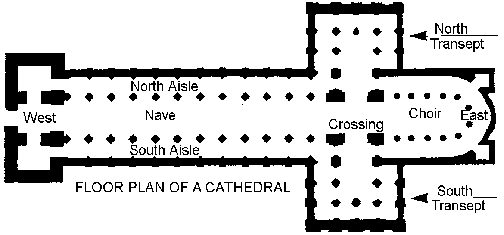
Romanesque Cathedrals floor plans are a lot less complicated (figure 5). They are designed like a cross but there are not many entrances or windows and would be easy to hold of attackers. A Gothic cathedral's floor plan (figure 6) is a lot more complex. There are windows everywhere and if someone was attempting to break in it would be a lot easier than trying to break into an old Romanesque Cathedral.
Romanesque and Gothic Cathedrals express many diffrent understandings of religious theology. Romanesque cathedrals are built for more safety and less artistic appeal because they were constructed in times of war. Gothic cathedrals have a lot of architecture and even though are not very defensive looking they did not have to be because they were not constructed while wars were raging.


Picture Bibliography
(figure one) Cathedral of Salmanca, facade, 11th century Shttp://upload.wikimedia.org/wikipedia/commons/thumb/0/04/Cathedral_of_Salamanca_Romanesque.jpg/750px-Cathedral_of_Salamanca_Romanesque.jpg, 15 October, 2006
(figure two) San Zeno, facade, 13th century http://upload.wikimedia.org/wikipedia/commons/thumb/8/81/San_Zeno1.JPG/800px-San_Zeno1.JPG, 21 january 2006
(figure three) Rose Window, Inside, 13th century, http://www.visitingdc.com/images/rose-window.jpg, 13 June, 2000
(figure four) Gothic Cathedral, facade, 14th century http://upload.wikimedia.org/wikipedia/commons/c/ca/P-Gothic-cathedral.png, 9 june 2009
(figure five) Situacio catedral romanica, floorplan, 14th century
http://upload.wikimedia.org/wikipedia/commons/thumb/4/4c/Situaci%C3%B3_catedral_rom%C3%A0nica_Barcelona.png/567px-Situaci%C3%B3_catedral_rom%C3%A0nica_Barcelona.png, 30 october 2007
http://upload.wikimedia.org/wikipedia/commons/thumb/4/4c/Situaci%C3%B3_catedral_rom%C3%A0nica_Barcelona.png/567px-Situaci%C3%B3_catedral_rom%C3%A0nica_Barcelona.png, 30 october 2007
(figure six) Gothic Cathedral Parts, overview, 12th centuryhttp://upload.wikimedia.org/wikipedia/commons/thumb/1/1d/Gothic-Cathedral-parts002.jpg/517px-Gothic-Cathedral-parts002.jpg, 7 February 2010
Wednesday, April 27, 2011
Essay 2 rough draft
Romanesque and Gothic Cathedrals are very different styles of architecture. This is because these Cathedrals were built Romanesque cathedrals and Gothic cathedrals expressed different understandings about religious theology. Romanesque and Gothic Cathedrals did not express anything about religious theology.
Romanesque Cathedrals expressed the fortitude of the Christian Religion. Their Cathedrals were designed as places as worship but were also almost like castles. If there were a state of emergency they could easily gather in the Cathedral and be defended. The cathedrals also had towers sits bells that could be rung but were also equipped with slits for archers (figure 2). These cathedrals were heavily protected because they were built in a time of war.
Gothic Cathedrals were more arty. They were designed to "let the light in". They had big glass windows and the walls were not as thick (figure 4). They were very big as well but do not look as strong as many of the Roman Cathedrals. These cathedrals were built at a time of peace and there was not need for the cathedrals to be able to withstand an attack.
Romanesque Cathedrals floor plans are a lot less complicated (figure 5). They are designed like a cross but there are not many entrances or windows and would be easy to hold of attackers. A Gothic cathedral's floor plan (figure 6) is a lot more complex. There are windows everywhere and if someone was attempting to break in it would be a lot easier than trying to break into an old Romanesque Cathedral.
Romanesque and Gothic Cathedrals express many diffrent understandings of religious theology. Romanesque cathedrals are built for more safety and less artistic appeal because they were constructed in times of war. Gothic cathedrals have a lot of architecture and even though are not very defensive looking they did not have to be because they were not constructed while wars were raging.


Picture Bibliography
(figure one) http://farm1.static.flickr.com/198/513475855_f678b4ccf1.jpg
(figure two) http://us.123rf.com/400wm/400/400/tupungato tupungato1002/tupungato100200149/6388945-romanesque-bell-tower-of-prato-cathedral-tuscany-italy.jpg
(figure three) http://jcolen.com/GothicCathedralKoln1.jpg
(figure four) http://www.visitingdc.com/images/rose-window.jpg
(figure five) http://t3.gstatic.com/images?q=tbn:ANd9GcSkEv9z5mYldzOfNABlNhgRzNRyGphPPl4somQrhWm0 661Z Ky8u&t=19
(figure six) http//www.thephylaxis.org/Images/williams/cathedral%20floor%20plan.
bmp
Romanesque Cathedrals expressed the fortitude of the Christian Religion. Their Cathedrals were designed as places as worship but were also almost like castles. If there were a state of emergency they could easily gather in the Cathedral and be defended. The cathedrals also had towers sits bells that could be rung but were also equipped with slits for archers (figure 2). These cathedrals were heavily protected because they were built in a time of war.
Gothic Cathedrals were more arty. They were designed to "let the light in". They had big glass windows and the walls were not as thick (figure 4). They were very big as well but do not look as strong as many of the Roman Cathedrals. These cathedrals were built at a time of peace and there was not need for the cathedrals to be able to withstand an attack.
Romanesque Cathedrals floor plans are a lot less complicated (figure 5). They are designed like a cross but there are not many entrances or windows and would be easy to hold of attackers. A Gothic cathedral's floor plan (figure 6) is a lot more complex. There are windows everywhere and if someone was attempting to break in it would be a lot easier than trying to break into an old Romanesque Cathedral.
Romanesque and Gothic Cathedrals express many diffrent understandings of religious theology. Romanesque cathedrals are built for more safety and less artistic appeal because they were constructed in times of war. Gothic cathedrals have a lot of architecture and even though are not very defensive looking they did not have to be because they were not constructed while wars were raging.


Picture Bibliography
(figure one) http://farm1.static.flickr.com/198/513475855_f678b4ccf1.jpg
(figure two) http://us.123rf.com/400wm/400/400/tupungato tupungato1002/tupungato100200149/6388945-romanesque-bell-tower-of-prato-cathedral-tuscany-italy.jpg
(figure three) http://jcolen.com/GothicCathedralKoln1.jpg
(figure four) http://www.visitingdc.com/images/rose-window.jpg
(figure five) http://t3.gstatic.com/images?q=tbn:ANd9GcSkEv9z5mYldzOfNABlNhgRzNRyGphPPl4somQrhWm0 661Z Ky8u&t=19
(figure six) http//www.thephylaxis.org/Images/williams/cathedral%20floor%20plan.
bmp
Subscribe to:
Posts (Atom)